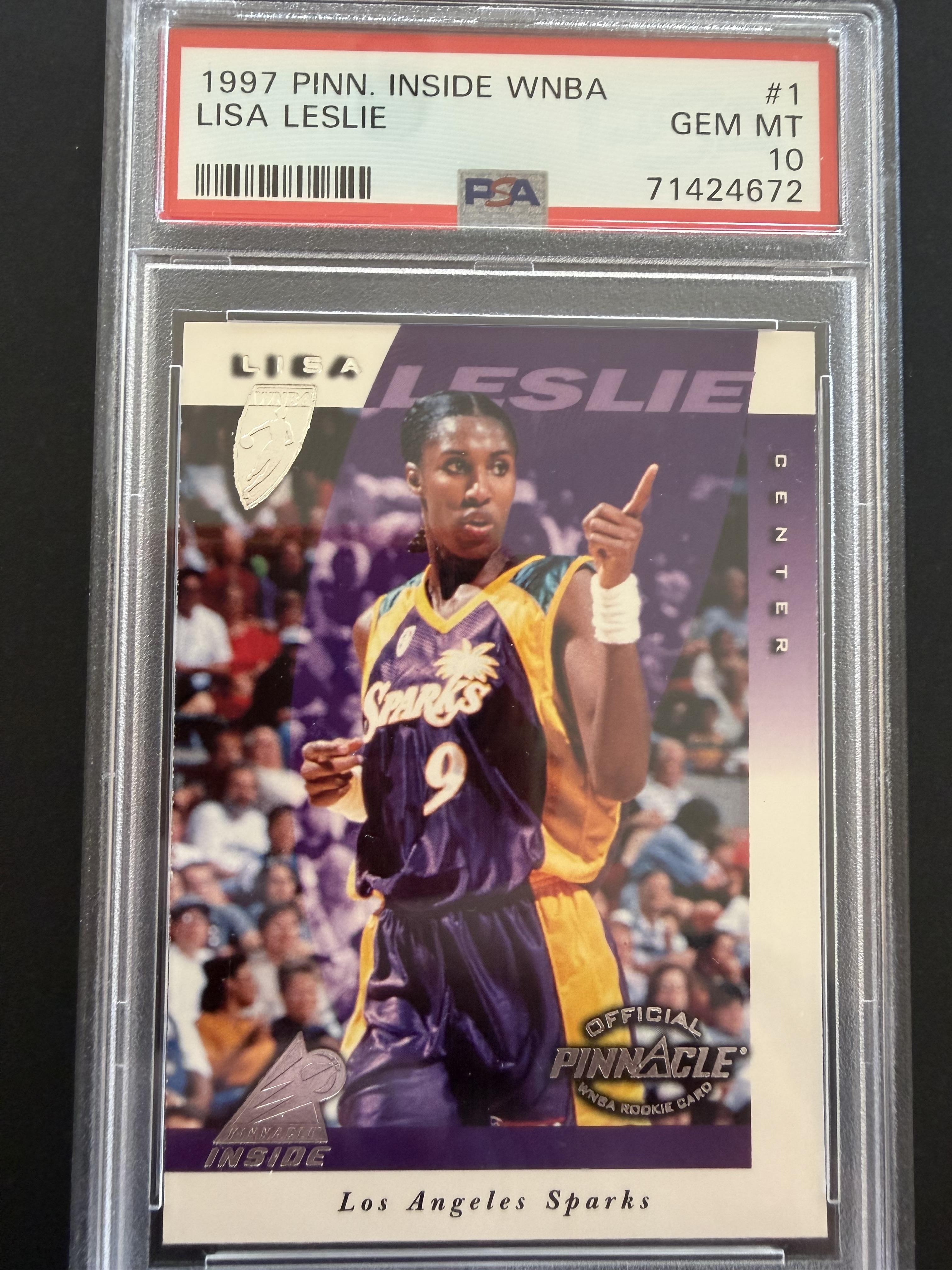
1997 Pinnacle Inside WNBA #1 — Lisa Leslie
Sometimes a basketball card is more than a basketball card.
It can be a photograph of a moment in time. It can remind us of a player we watched growing up. And sometimes, one small piece of cardboard can represent a much bigger story.
That is how I look at the 1997 Pinnacle Inside WNBA #1 Lisa Leslie card in my collection.
The card was produced during the inaugural season of the WNBA and is recognized by Beckett as a Lisa Leslie rookie card. The 82-card Pinnacle Inside set celebrated the players participating in the new professional women’s league and was distributed in an unusual way: the cards came packaged inside collectible cans containing ten cards each.[1]
My copy is graded PSA 10.
I enjoy owning a high-grade card, but the number on the PSA holder isn’t really why Lisa Leslie belongs in my collection.
She belongs because it would be difficult to tell the story of women’s basketball without telling the story of Lisa Leslie.
Long before today’s generation of girls could grow up watching WNBA games, following their favorite players on social media, buying signature shoes or dreaming openly about becoming professional basketball players, athletes such as Leslie were helping prove that a women’s professional basketball league could succeed.
And Lisa Leslie didn’t simply play in that league.
She helped define it.
Before There Was a WNBA Superstar
Lisa Leslie grew up in Southern California and became a basketball phenomenon at Morningside High School.
One of the most famous performances of her high school career almost sounds fictional today: Leslie once scored 101 points in the first half of a game.[2]
Her talent eventually took her to the University of Southern California.
At USC, Leslie developed into one of the greatest players in the history of the program. She became a four-time All-Pac-10 First Team selection from 1991 through 1994—the first player in conference history to accomplish that feat—and a three-time All-American.[2]
As a freshman, she led the nation in both scoring and rebounding and was named National Freshman of the Year.
By the time her college career ended, Leslie had scored 2,414 points, grabbed 1,214 rebounds and blocked 321 shots for USC. In 1994, she was the unanimous Naismith National Player of the Year.[2]
Those statistics are impressive.
But what happened after college would eventually make Leslie far more important to women’s basketball than any collection of numbers could explain.
The problem was simple.
There was no WNBA yet.
A Generation That Needed Somewhere to Play
Today, young basketball players can watch Caitlin Clark, A’ja Wilson, Breanna Stewart, Napheesa Collier and other WNBA stars and understand exactly where elite women’s basketball can lead.
Lisa Leslie’s generation did not have that same road in front of them.
There was outstanding women’s college basketball. There were opportunities overseas. There was the United States National Team.
But there was not yet a stable American women’s professional basketball league waiting for the country’s best players.
That began to change in the middle of the 1990s.
One of the most important events in the history of American women’s basketball occurred before the first WNBA game was ever played.
The 1996 United States Olympic team included Leslie alongside players such as Sheryl Swoopes, Rebecca Lobo, Dawn Staley, Teresa Edwards and Katrina McClain.
That team did far more than win basketball games.
Beginning in 1995, the national team embarked on an extended tour designed to prepare for the Atlanta Olympics and showcase elite women’s basketball around the country. The team eventually won 60 games during its journey and finished the 1996 Olympics with an 8-0 record and a gold medal.[3]
The Naismith Memorial Basketball Hall of Fame credits that team with helping pave the way for the WNBA and demonstrating the viability of women’s professional basketball in the United States.[3]
Lisa Leslie was right in the middle of it.
During the Atlanta Olympics, she scored 35 points against Japan—a U.S. Olympic women’s single-game scoring record that USA Basketball still lists among her accomplishments.[4]
The United States won gold.
And less than a year later, another chapter began.
June 21, 1997
The WNBA tipped off its first game on June 21, 1997.
The matchup featured the New York Liberty and the Los Angeles Sparks.
Lisa Leslie was wearing a Sparks uniform.[5]
Think about that for a moment.
The player pictured on my 1997 Pinnacle card wasn’t joining an established league with decades of history.
She was helping create the history.
Every arena was new.
Every record was waiting to be established.
Every first mattered.
And there were no guarantees about what the WNBA would become.
Leslie spent her entire professional career with the Los Angeles Sparks, and during the years that followed she became one of the defining players of the league’s first generation.
Becoming the Face of a League
By 2001, Lisa Leslie and the Sparks had become one of the dominant teams in women’s professional basketball.
That season, Los Angeles finished with a league-best 28-4 record, while Leslie averaged 19.5 points per game and earned her first WNBA Most Valuable Player award.[6]
Then came the championship.
The Sparks defeated the Charlotte Sting to win the 2001 WNBA title, and Leslie was named Finals MVP.
Her season was historic for another reason.
Leslie became the first WNBA player to win the regular-season MVP, All-Star Game MVP and WNBA Finals MVP in the same season.[7]
Los Angeles wasn’t finished.
In 2002, the Sparks repeated as WNBA champions, this time defeating the New York Liberty. Leslie again earned Finals MVP honors.[8]
But another moment from that season may have had an even greater cultural impact.
The Dunk
On July 30, 2002, Lisa Leslie became the first player to dunk in a WNBA game.[9]
One basket.
Two points.
But symbolically, it meant much more.
For generations, dunking had been used—fairly or unfairly—as one of the dividing lines people used when comparing men’s and women’s basketball.
Then Leslie took off and put the ball through the rim.
The highlight became part of WNBA history.
More importantly, another barrier had disappeared.
A little girl watching basketball no longer had to imagine whether a woman could dunk in a professional game.
She had seen it.
That is one of the things sports pioneers do.
They make something that once seemed unusual become possible.
Then another generation comes along and makes it normal.
Four Olympic Gold Medals
Leslie’s influence wasn’t limited to the WNBA.
She became one of the most accomplished Olympic basketball players in American history.
Leslie won Olympic gold medals in 1996, 2000, 2004 and 2008.[4]
When she won her fourth consecutive gold medal in Beijing, USA Basketball noted that she became the first basketball player to win four consecutive Olympic gold medals.[4]
Across those four Olympic appearances, Leslie accumulated 488 points, 241 rebounds and 37 blocked shots, all U.S. Olympic records at the time cited by USA Basketball.[4]
She also helped the United States win two FIBA World Cup gold medals and was named MVP of the 2002 World Cup.[4]
Imagine maintaining that level of excellence for more than a decade.
College superstar.
Olympic champion.
Professional champion.
League MVP.
And then doing it again.
And again.
When the Career Was Over
Lisa Leslie retired following the 2009 WNBA season.
By then her résumé included:
- Two WNBA championships
- Three WNBA Most Valuable Player awards
- Two WNBA Finals MVP awards
- Two WNBA Defensive Player of the Year awards
- Eight All-WNBA First Team selections
- Eight WNBA All-Star selections
- Four Olympic gold medals
- The first dunk in WNBA history.[10]
When she retired, the WNBA identified Leslie as its all-time leader in both points and rebounds.[5]
Her accomplishments eventually resulted in induction into both the Women’s Basketball Hall of Fame and the Naismith Memorial Basketball Hall of Fame in 2015.[10][11]
But statistics and Hall of Fame plaques still don’t completely explain why Lisa Leslie matters.
What Young Players Can Learn From Lisa Leslie
One of the reasons I wanted to create this series is that basketball history can teach young athletes lessons that go far beyond basketball.
Lisa Leslie’s story provides several.
You Don’t Have to Wait for the Path to Exist
When Leslie finished college, the WNBA did not exist.
There was no established American professional women’s league offering her the same path available to today’s players.
Her generation helped build that path.
Young athletes sometimes believe success means following a perfectly defined road.
It doesn’t.
Sometimes the opportunity you are preparing for hasn’t even been created yet.
That doesn’t make the preparation meaningless.
It makes preparation even more important.
Great Players Keep Adding to Their Games
Leslie arrived in professional basketball as an elite player.
She didn’t stop there.
She eventually became a three-time league MVP, a two-time Defensive Player of the Year and a two-time champion.
Talent may open doors.
Continued improvement is what allows athletes to stay there.
Someone Has to Be First
Someone had to play in the first WNBA game.
Someone had to become the league’s first player to dunk.
Someone had to help demonstrate that women’s professional basketball belonged on television and in major arenas.
Lisa Leslie was part of many of those firsts.
Today’s young players benefit from opportunities created by women who played before them.
Understanding that history should create gratitude—but it should also create responsibility.
Today’s players are building opportunities for the girls who will follow them.
What Basketball Parents Can Learn
There is also a lesson for us as parents.
We often become consumed with what is directly in front of our children.
Playing time.
Points.
Starting positions.
AAU teams.
Scholarship offers.
Rankings.
Those things can feel enormously important while we are living through them.
But Lisa Leslie’s career is a reminder to widen the lens.
A young athlete’s basketball experience isn’t only about the next game.
Basketball can teach confidence, discipline, resilience, teamwork and the ability to perform when expectations are high.
Very few girls who play youth basketball will become Lisa Leslie.
That should never be the standard.
Our job as parents isn’t to manufacture professional basketball players.
It is to help our daughters use basketball to become stronger people.
And sometimes sharing the stories of athletes who came before them helps us do exactly that.
Why This Card Is in My Collection
That brings me back to the card.
1997 Pinnacle Inside WNBA #1 Lisa Leslie.
PSA 10.
I certainly appreciate the condition and collectability of the card.
But someday I hope my women’s basketball collection tells a story.
Not simply which cards were valuable.
Not simply which cards were rare.
I want it to tell the story of the women who helped build the game.
If someone were to look through that collection decades from now, I would want them to understand how women’s basketball traveled from one generation to another.
There will be cards representing the pioneers.
There will be cards representing the first generation of WNBA stars.
There will be cards from the women who carried the league forward.
And there will be cards from today’s generation, which is taking women’s basketball to places previous generations could only imagine.
Lisa Leslie belongs near the beginning of that story.
Because before today’s players could dream about becoming WNBA superstars, women like Lisa Leslie had to prove that there could be WNBA superstars at all.
That is why this card is in my collection.
And that is the story behind the card.
A note on this article: I used AI tools to help research, organize, and refine this article. The personal reflections and perspective are my own, and I reviewed and edited the final version. Sources are listed above for readers who would like to explore Lisa Leslie’s story further.
Footnotes and Sources
[1] Beckett Media, “1997 Pinnacle Inside WNBA #1 Lisa Leslie RC.” Beckett identifies the Leslie #1 as an RC and describes the 1997 Pinnacle Inside WNBA release as an 82-card set honoring players from the WNBA’s inaugural season, distributed in ten-card cans.
[2] USC Athletics, “Lisa Leslie — USC Athletics Hall of Fame.” USC documents Leslie’s Morningside High School 101-point half, four All-Pac-10 First Team selections, three All-America selections, 1994 Naismith award, and USC career statistics.
[3] Naismith Memorial Basketball Hall of Fame, “1996 United States Women’s National Team.” The Hall of Fame describes the national team’s 60-game journey, undefeated Olympic run and role in paving the way for the creation and growth of the WNBA.
[4] USA Basketball, “Four-Time Olympic Gold Medalist Lisa Leslie to be Inducted into U.S. Olympic & Paralympic Hall of Fame,” September 23, 2019. USA Basketball documents Leslie’s four Olympic gold medals, Olympic scoring and rebounding records, 35-point game and World Cup accomplishments.
[5] WNBA, “Black History Month Player Spotlight: Lisa Leslie.” The WNBA recounts Leslie’s participation in the league’s inaugural game, her championships, scoring milestones and status as the league’s all-time leader in points and rebounds when she retired.
[6] WNBA, “Sparks’ Leslie Wins 2001 WNBA MVP,” August 26, 2001. Contemporary WNBA coverage documents Leslie’s first league MVP award, 19.5-point scoring average and the Sparks’ 28-4 regular-season record.
[7] Los Angeles Sparks, “Historical Timeline.” The Sparks’ franchise history records Leslie becoming the first WNBA player to capture the regular-season, All-Star and Finals MVP awards in the same season and the Sparks winning their first championship in 2001.
[8] WNBA, “WNBA Champions Through the Years.” The league’s championship history documents Los Angeles winning consecutive titles in 2001 and 2002 and Leslie earning Finals MVP in both seasons.
[9] WNBA, “WNBA History Timeline.” The WNBA’s historical timeline records Leslie becoming the first player to dunk in a WNBA game on July 30, 2002.
[10] Los Angeles Sparks, “Lisa Leslie Statue Celebration.” The Sparks summarize Leslie’s major professional accomplishments, including three MVP awards, two championships, two Defensive Player of the Year awards, eight All-WNBA First Team selections and the first dunk in WNBA history.
[11] Naismith Memorial Basketball Hall of Fame, “Lisa Leslie.” Leslie was enshrined in the Naismith Memorial Basketball Hall of Fame in 2015; the Hall documents her professional, Olympic and championship accomplishments.
Additional Reference: Women’s Basketball Hall of Fame, “Lisa Leslie,” Class of 2015.