When my wife and I had our first child, there was very little doubt that sports would become part of her life.
Both of us had been college basketball players. Athletics had shaped much of our childhood and young-adult lives, and we wanted our children to have some of the same opportunities.
Sports could teach them discipline.
Competition.
Teamwork.
How to handle success.
How to respond to failure.
And perhaps most importantly, they could create friendships and memories that might last a lifetime.
There was only one problem.
Nobody gave me an instruction manual for becoming a youth sports parent.
I had plenty of experience playing sports.
I had coached.
I understood basketball.
But knowing the game and knowing how to parent a child through the game turned out to be two very different things.
That realization is one of the primary reasons I eventually created Youth Basketball Parent.
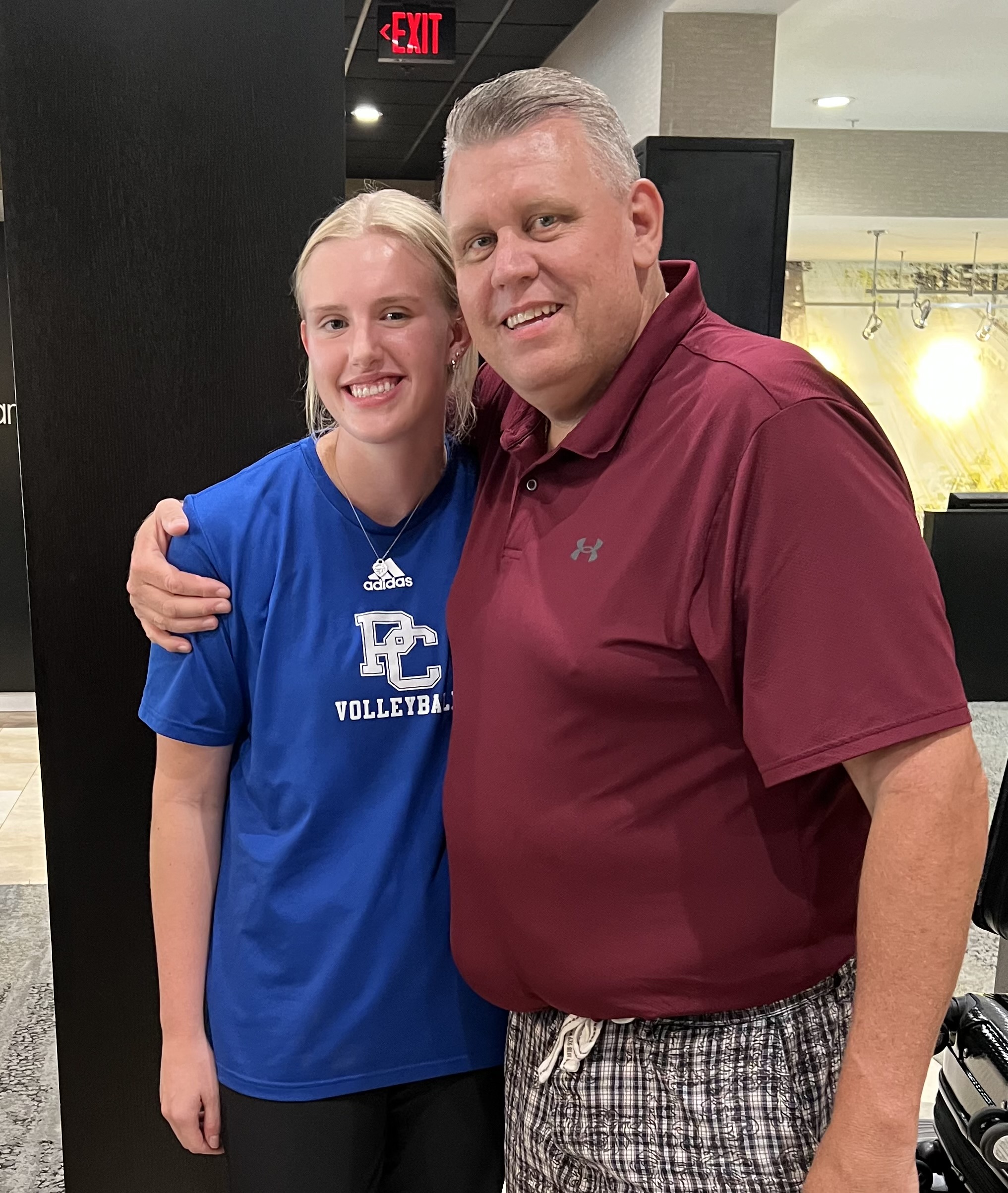
Before my oldest daughter, Hailey, returned to college to prepare for another volleyball season, I sat down with her and asked her to look back on her youth and high school basketball experience.
We talked about coaches.
We talked about games.
We talked about mistakes.
And eventually, I asked her a question that made me a little nervous.
“If you had to give me a grade as a youth basketball parent, what would it be?”
Before I reveal the answer, you probably need to understand the journey.
The Early Years
Hailey began playing basketball at the YMCA when she was in second grade.
I served as an assistant coach on her teams from second through fifth grade.
By fifth grade, she had also begun working with a personal basketball trainer on ball handling, finishing around the basket, footwork, and shooting.
Hailey was usually one of the tallest girls on the court.
But when she was young, she didn’t necessarily look like a natural basketball player.
She was growing into her body and could occasionally appear a little awkward.
Because she was tall, almost every youth coach immediately placed her in the post.
That became her basketball identity.
Tall kid equals post player.
She was rarely allowed to handle the basketball during games, even though she was developing pretty good ball-handling skills during individual workouts.
Her shooting improved.
Her footwork improved.
Her perimeter skills improved.
But during games, she continued spending most of her time around the basket.
Looking back, I think that experience taught me something I later carried into my younger daughter’s development:
Don’t allow a young player’s current height to determine the limits of her future game.
Kids grow at different rates.
Positions change.
Bodies change.
The tall fifth grader may eventually become a high school wing.
The small point guard may grow six inches.
Young players should develop basketball skills—not simply positions.
Unfortunately, basketball development wasn’t the only challenge Hailey encountered.
When Basketball Stopped Being Fun
Years later, Hailey told me that she enjoyed basketball when she was little.
But gradually, some of that enjoyment began disappearing.
She still remembers several experiences with youth coaches.
In fifth grade, her team played against her childhood friend Olivia Sobczak.
Olivia’s father and I had been college basketball teammates, so the girls knew one another well.
When Hailey entered the game, she ran over to Olivia, gave her a hug, and said hello.
Her coach became upset.
He told her she shouldn’t be friendly with the competition.
To an adult coach, maybe that seemed like an attempt to teach competitiveness.
To a fifth-grade girl, it sent a different message.
Basketball was becoming serious enough that apparently hugging your friend was wrong.
Another time, Hailey forgot to remove her earrings before a game.
The referee stopped play.
Her coach removed her from the game and harshly criticized her for the mistake.
Then came a moment she remembers even more clearly.
During sixth grade, a coach pulled her aside and told her that maybe she should consider finding a different sport.
That one hurt.
A lot.
In seventh grade, she suffered a high ankle sprain and missed approximately two months.
Her team had a limited roster, so her absence created problems.
As the injury lingered, her coach questioned whether Hailey should already have returned and even suggested she might be exaggerating the injury because of her volleyball obligations.
My wife and I eventually took Hailey to an orthopedic specialist, who confirmed that the injury was legitimate.
Then, during her eighth-grade AAU season, she felt as though she played with an incredibly short leash.
Make one mistake?
Come out of the game.
Another mistake?
Back to the bench.
That kind of environment can be difficult for any player, but particularly for a young athlete already struggling with confidence.
When I asked Hailey about those experiences years later, she gave me an observation that stuck with me.
She felt that some youth coaches cared far too much about winning.
In her words, sometimes it felt like the adults made the games about themselves instead of the kids.
That comment should make every youth coach—and every youth sports parent—think.
Then There Was Dad
Unfortunately, the coaches weren’t the only adults contributing to Hailey’s difficult experience.
There was another problem.
Me.
Looking back, some of my behavior toward her was terrible.
I expected far too much.
I expected her to play well.
I expected her to score.
I yelled at referees.
At times, I made a spectacle of myself in the stands.
And when the game ended, the pressure didn’t always end with it.
Hailey told me that she often felt pressure while she was playing and then experienced more criticism once she got into the car.
Instead of providing a safe place after the game, I sometimes turned the ride home into an evaluation session.
What did you do wrong?
Why didn’t you do this?
Why didn’t you do that?
You should have taken that shot.
You should have played harder.
You should have boxed out.
You should have…
You should have…
You should have…
I cringe thinking about some of it now.
One moment in particular still bothers me.
During Hailey’s seventh-grade season, she played a game in Oak Creek.
I thought she had played terribly.
Afterward, I cornered her in a hallway and criticized her until she cried.
Even writing that sentence today makes me feel awful.
What exactly did I accomplish?
Did I make her a better basketball player?
No.
Did I increase her confidence?
Certainly not.
Did I make the game more enjoyable?
Obviously not.
What I probably did was make a 13-year-old girl feel as though her basketball performance had disappointed her father.
That is a terrible message to send.
My Own Learning Curve
The good news is that the longer I remained involved in youth sports, the more I began learning.
Unfortunately, some lessons came too late to completely change Hailey’s experience.
But they changed me.
I gradually began understanding that the game wasn’t about me.
My child’s statistics weren’t my statistics.
Her victories weren’t my victories.
Her mistakes weren’t a reflection of me.
And screaming instructions from the stands rarely accomplished anything positive.
Eventually, I realized the place where I could have the greatest impact wasn’t during the game at all.
It was before and after.
In the driveway.
In the gym.
Helping her develop skills.
Encouraging her.
Listening.
Supporting.
Then, when the game started, I needed to allow the coaches to coach and allow my daughter to play.
That sounds incredibly simple now.
It wasn’t simple for me then.
I am intensely competitive.
Learning to separate my competitive instincts from my child’s athletic experience was one of the hardest things I had to do as a sports parent.
And I didn’t always succeed.
That is exactly why I feel so strongly about sharing these stories.
If another parent recognizes some of his or her own behavior in mine and changes course earlier than I did, then perhaps some of my mistakes can serve a purpose.
High School Basketball
Despite all the ups and downs of youth basketball, Hailey earned a spot on her high school’s varsity basketball team as a freshman.
That should have been an exciting accomplishment.
But by then, basketball had become complicated for her.
Her high school coach was intense, and Hailey did not find practices or games particularly enjoyable.
During her freshman and sophomore seasons, her relationship with basketball continued to deteriorate.
At the same time, something very different was happening in volleyball.
Hailey also made varsity volleyball as a freshman.
And she began thriving.
She experienced success with both her high school and club volleyball programs.
She loved the sport.
She found confidence.
She found an environment that fit her.
By the end of her sophomore basketball season, she sat down with my wife and me.
She had made a decision.
She was quitting basketball.
I was stunned.
I understood why she wanted to do it.
But I didn’t agree.
A big part of me still saw the basketball player I believed she could become.
But this time, I did something that perhaps an earlier version of me would not have done.
I let her make the decision.
I didn’t force her to continue playing because basketball mattered to me.
She chose volleyball.
And she flourished.
Her game continued improving until she eventually earned a Division I volleyball scholarship to Presbyterian College in South Carolina.
The child who had once been told that perhaps she should find another sport eventually found the sport that was right for her.
There is a lesson in that too.
Sometimes our children’s journey isn’t supposed to follow the path we imagined for them.
The Report Card
Years later, Hailey and I sat down and talked about all of it.
The coaches.
The games.
The pressure.
The car rides.
The tears.
The volleyball.
The mistakes I had made.
Finally, I asked the question.
“What grade would you give me as a youth basketball parent?”
I was prepared for something ugly.
C-minus?
D?
Maybe she would simply laugh and refuse to answer.
Instead, she surprised me.
B+.
I looked at her.
“B+? Really?”
I asked why the grade wasn’t much worse.
Her answer meant more to me than she probably realized.
She told me that through everything—the pressure, the mistakes, the craziness—I continually told her that I believed in her.
Even when she felt like the entire basketball world was against her, she knew her dad believed she was good enough.
I told her she could play college sports.
I told her she had ability.
I told her I believed in her.
And despite the times when I was too hard on her, she said she always knew that I loved her and genuinely believed I was trying to help.
Apparently, I did a few things right.
I will admit:
That brought a tear to my eye.
But it also made me think.
A B+ sounds pretty good.
I’m not sure I deserved it.
What I Would Do Differently
If someone offered me a time machine and allowed me to relive Hailey’s youth basketball years, I would absolutely take the opportunity.
I wouldn’t change everything.
But I would change quite a bit.
I would:
- Make fun and development more important than winning at young ages.
- Stop providing immediate postgame criticism. The car ride home would be for support, not film study without the film.
- Find one thing she did well and talk about that first.
- Address legitimate concerns with coaches calmly and privately rather than allowing frustrations to build.
- Continue helping her develop a complete skill set regardless of the position she happened to play on a youth team.
- Remind myself constantly that a fifth-grade basketball game’s final score has absolutely no importance in the larger picture of my child’s life.
- Listen more.
- Talk less.
Most importantly, I would try much harder to enjoy it.
Because there is something you don’t understand when your child is eight, nine, or ten years old:
It ends.
The endless tournaments eventually aren’t endless.
The Saturday mornings in the gym disappear.
The practices stop.
The uniforms get put away.
And suddenly you would give almost anything for one more weekend sitting in an uncomfortable set of bleachers watching your child play.
The Grade I Give Myself
Hailey gave me a B+.
I’ll take it.
But if I’m grading myself, I think the score is probably a little lower.
Not because I didn’t love her.
I loved her more than anything.
And not because I didn’t invest time in her development.
I did.
My mistake was sometimes confusing wanting the best for my child with knowing what was best for my child.
Those are not always the same thing.
That may be the greatest lesson Hailey’s basketball journey taught me.
Our job as parents is not to write our children’s story for them.
We can guide.
We can encourage.
We can set expectations.
We can provide opportunities.
We can help them work.
And we can tell them we believe in them.
But eventually, the story belongs to them.
Hailey’s basketball story did not end the way I once imagined.
She found volleyball.
She earned a Division I scholarship.
She found her own path.
And years later, she was generous enough to give her dad a B+.
I’ll always be grateful for the grade.
But I’m much more grateful for what the experience taught me.
Because when my younger daughter continued her basketball journey, I wasn’t the same basketball parent I had been the first time around.
I had learned.
Not perfectly.
But enough to be better.
And maybe that’s the real goal of parenting.
Not perfection.
Progress.