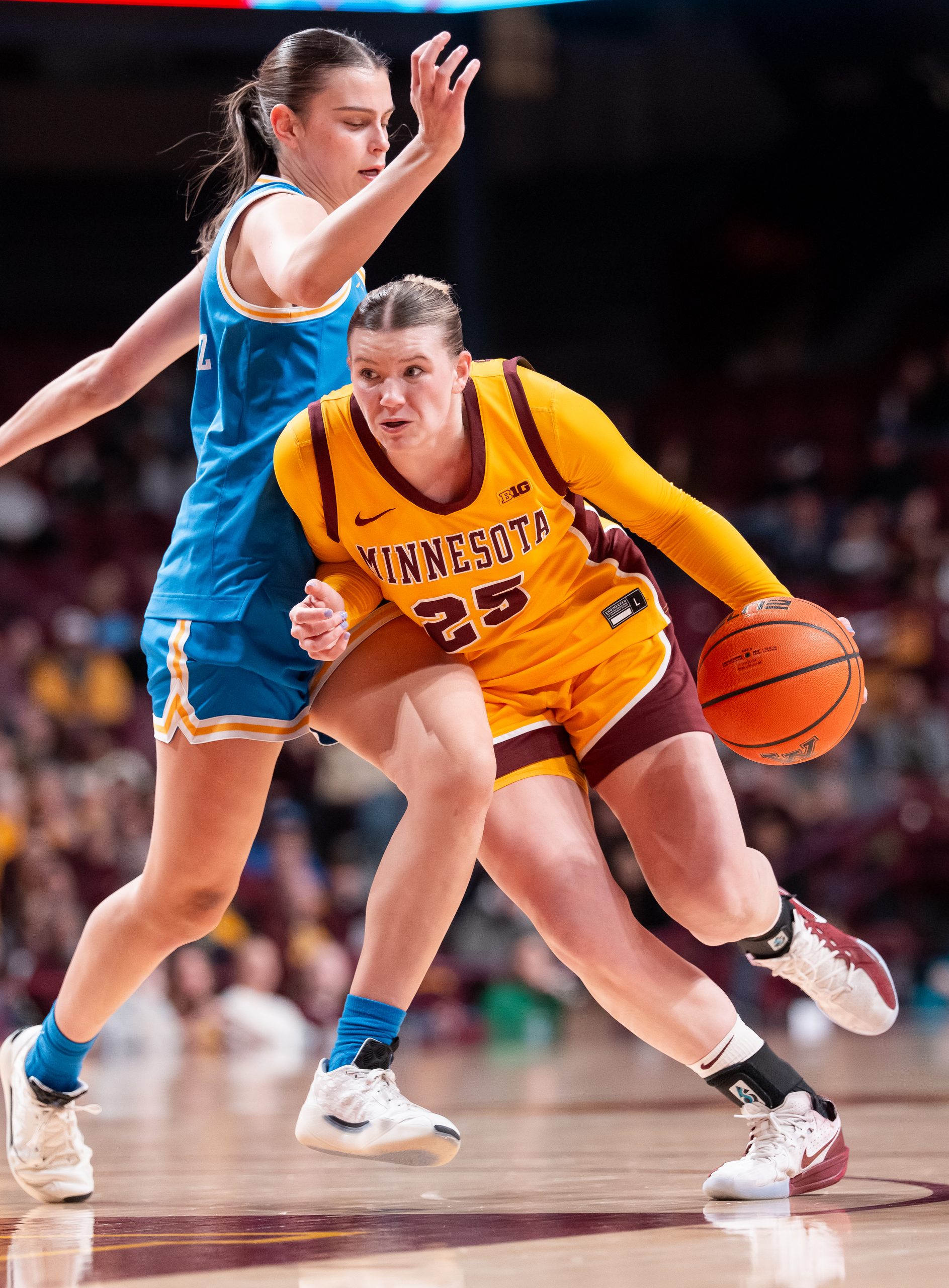
Photo Credit: Gopher Athletics
My daughter Grace was playing in a game during the May college exposure period.
More than 30 college coaches lined the sidelines, evaluating players from both teams.
I can only imagine the pressure those young athletes must have felt.
Grace started the game extremely well. She scored nine of her team’s first 14 points, eventually forcing the opposing coach to call a timeout.
As her father, I was obviously enjoying the start.
After the timeout, however, something changed.
A different player began guarding Grace.
Almost immediately, the matchup became much more physical.
The defender grabbed at her jersey.
She held her while Grace tried to cut.
At other times, when Grace was moving up the court, the defender appeared to deliberately step into her path at the last moment, seemingly hoping Grace would trip or run into her.
The referees either didn’t see everything that was happening or chose not to call it.
Naturally, the father in me didn’t enjoy watching it.
Nobody wants to see his or her child being grabbed, shoved, or subjected to unnecessary physical play.
But over the years, I have learned that moments like these can also create valuable conversations between parents and young athletes.
I certainly don’t believe cheap shots should be encouraged or ignored. Dangerous behavior should be addressed by coaches and officials.
But when adversity does occur, there may still be something our children can learn from it.
I see three important lessons.
1. Life Isn’t Always Fair — Be Ready Anyway
When our children are young, our natural instinct is to protect them.
We don’t want them to be disappointed.
We don’t want them to be treated unfairly.
We don’t want them to fail.
And we certainly don’t want someone else intentionally making life more difficult for them.
But at some point, every child discovers an uncomfortable truth:
Life isn’t always fair.
Neither is basketball.
A referee will miss a call.
A coach may make a decision your child doesn’t agree with.
Another player may get an opportunity your daughter believes she deserved.
An opponent may play more physically than she should.
Your child may work incredibly hard and still lose.
As parents, I don’t think our responsibility is to convince our children that the world will always treat them fairly.
Our responsibility is to help prepare them for the moments when it doesn’t.
That doesn’t mean becoming cynical.
It doesn’t mean expecting everyone to behave badly.
And it certainly doesn’t mean tolerating dangerous or abusive behavior.
It means understanding that adversity is part of life.
I have experienced some of my greatest periods of personal growth after difficult situations.
At the time, I certainly didn’t enjoy them.
But struggle has a funny way of revealing what we are capable of handling.
The same thing happens in basketball.
Your child misses the game-winning shot.
What happens next?
She gets benched.
How does she respond?
An opponent plays extremely physically.
Does she lose her composure?
The game occasionally places young athletes into uncomfortable situations where they have to decide how they are going to react.
Those situations won’t disappear when basketball ends.
There will eventually be difficult professors.
Difficult bosses.
Difficult coworkers.
Unfair decisions.
Disappointments.
Failure.
We can’t remove every obstacle from our children’s lives.
But we can help them develop the ability to deal with one.
Maybe the old saying should be:
Life isn’t always fair. Wear a helmet—and keep moving forward.
2. Poise in Conflict: Choose Your Response Carefully
One of my favorite examples of this lesson happened during a tournament in Chicago.
The game had become extremely physical.
Grace was working to establish position in the post when the player defending her suddenly delivered a hard elbow to her chest.
I held my breath.
I knew exactly how I probably would have reacted at her age.
I waited for Grace’s response.
Nothing.
She didn’t retaliate.
She didn’t get into the girl’s face.
She didn’t even give her a dirty look.
She simply continued fighting for position.
After the game, I asked her about it.
“Why didn’t you say something to her? Why didn’t you react?”
Her answer surprised me.
She essentially told me:
“Because the referee would probably see me retaliate, and then I’d get the technical foul. I’d rather win the game than deal with that nonsense.”
I remember thinking:
Well, she certainly didn’t learn that from me.
During my playing days, there is a good chance I would have spent the next several minutes looking for an opportunity to return the favor.
Thankfully, my daughter demonstrated better judgment than her father probably would have.
And that taught me something too.
There is a tremendous difference between being tough and losing control.
Sometimes the tougher response is doing nothing.
Self-control is not weakness.
Walking away isn’t cowardice.
Keeping your eyes on the larger objective requires discipline.
Grace understood something in that moment:
Retaliating might feel satisfying for five seconds.
Getting a technical foul could hurt her team for the rest of the game.
She chose the team.
That is basketball maturity.
It is also life maturity.
People will occasionally try to provoke our children.
Someone may say something insulting.
A coworker may eventually criticize them unfairly.
A competitor may try to frustrate them.
The instinctive response may be to immediately fight back.
Sometimes that is necessary.
Often it isn’t.
The more important question is:
What response helps me accomplish my ultimate goal?
Character is often revealed when circumstances aren’t going our way.
Anybody can remain composed when everything is easy.
The real test comes when someone gives you a reason not to.
3. Success Often Brings More Attention
There is a line I once heard in a television show or movie:
“If they’re shooting at you, you must be doing something right.”
I obviously don’t mean that literally.
But there is an interesting truth hidden inside the idea.
As players become more successful, opponents begin paying more attention to them.
A great shooter gets face-guarded.
A dominant post player gets double-teamed.
A talented ball handler gets pressured for 94 feet.
A team’s leading scorer may receive the opponent’s best defender every night.
And sometimes frustrated defenders become overly physical.
Why?
Because the player has become a problem.
Watch someone like Stephen Curry move without the basketball.
Defenders grab him.
They bump him.
They fight through screens.
They make every cut difficult.
Why?
Because allowing Steph Curry to move freely around the court is not a particularly good defensive strategy.
Obviously, there is an important distinction between physical basketball and dirty play.
Holding, dangerous contact, or deliberate cheap shots should never be viewed as acceptable simply because a talented player is receiving them.
But young athletes should understand that improvement often makes the game more difficult.
When your daughter was unknown, maybe opponents didn’t build a game plan around her.
Once she becomes one of the better players on the floor, that changes.
Now the defense knows her number.
Now coaches are telling players:
“Don’t leave her.”
“Make her uncomfortable.”
“Get into her.”
“Don’t let her catch the ball.”
In a strange way, that is a compliment.
It means opponents respect what she can do.
I have seen similar situations in the business world.
People who perform well sometimes attract greater scrutiny.
Competitors pay closer attention.
Expectations rise.
Sometimes jealousy appears.
Success doesn’t always make life easier.
Occasionally, success simply creates better competition.
That is something I want my daughters to understand.
If people begin working harder to stop you, don’t complain that things used to be easier.
Get better.
Adjust.
Become stronger.
Move without the ball more effectively.
Learn another way to score.
Improve your decision-making.
The objective shouldn’t be to hope the opposition stops paying attention to you.
The objective should be to become so good that their attention still isn’t enough.
The Parent’s Role From the Sideline
There is another lesson here that may be directed more toward us as parents than toward our children.
It is incredibly difficult to remain calm when you believe another player is taking cheap shots at your child.
Every protective instinct kicks in.
You want the referee to call it.
You want the coach to do something.
You may even feel like yelling directly at the opposing player.
I’ve certainly experienced those emotions.
But our children are watching us too.
If we completely lose control every time something goes wrong, what lesson are we teaching them about composure?
That doesn’t mean parents should ignore legitimate safety concerns.
If play becomes dangerous, speak with your child’s coach. Allow coaches and officials to address it. If necessary, remove your child from an unsafe situation.
But there is a difference between protecting your child and escalating the conflict yourself.
Sometimes the lesson we want our children to learn begins with the behavior we demonstrate from the stands.
Don’t Waste the Teaching Opportunity
Would I prefer that my daughters never experience a cheap shot?
Absolutely.
Would I prefer that every official see every foul?
Of course.
Would I prefer that every opponent display perfect sportsmanship?
Certainly.
But that’s not reality.
And when something unpleasant does happen, I don’t want to waste the opportunity.
Talk about it afterward.
Ask your child:
What happened?
How did you feel?
Why do you think the opponent behaved that way?
Do you think you responded correctly?
What would you do differently next time?
Those conversations matter.
Basketball provides young athletes with a relatively safe place to experience emotions and situations that will appear again later in life.
Frustration.
Conflict.
Unfairness.
Pressure.
Competition.
Jealousy.
Adversity.
We can’t eliminate those experiences from our children’s lives.
But we can help them learn how to navigate them.
So the next time an opponent gets overly physical with your child, resist the urge to immediately view the entire experience as negative.
Make sure your child is safe.
Make sure the appropriate adults address dangerous behavior.
Then, when the emotion settles down, have the conversation.
Because sometimes an opponent’s worst behavior can provide one of our best parenting opportunities.
And if they’re suddenly working that hard to stop your child?
Well…
She may be doing something right.