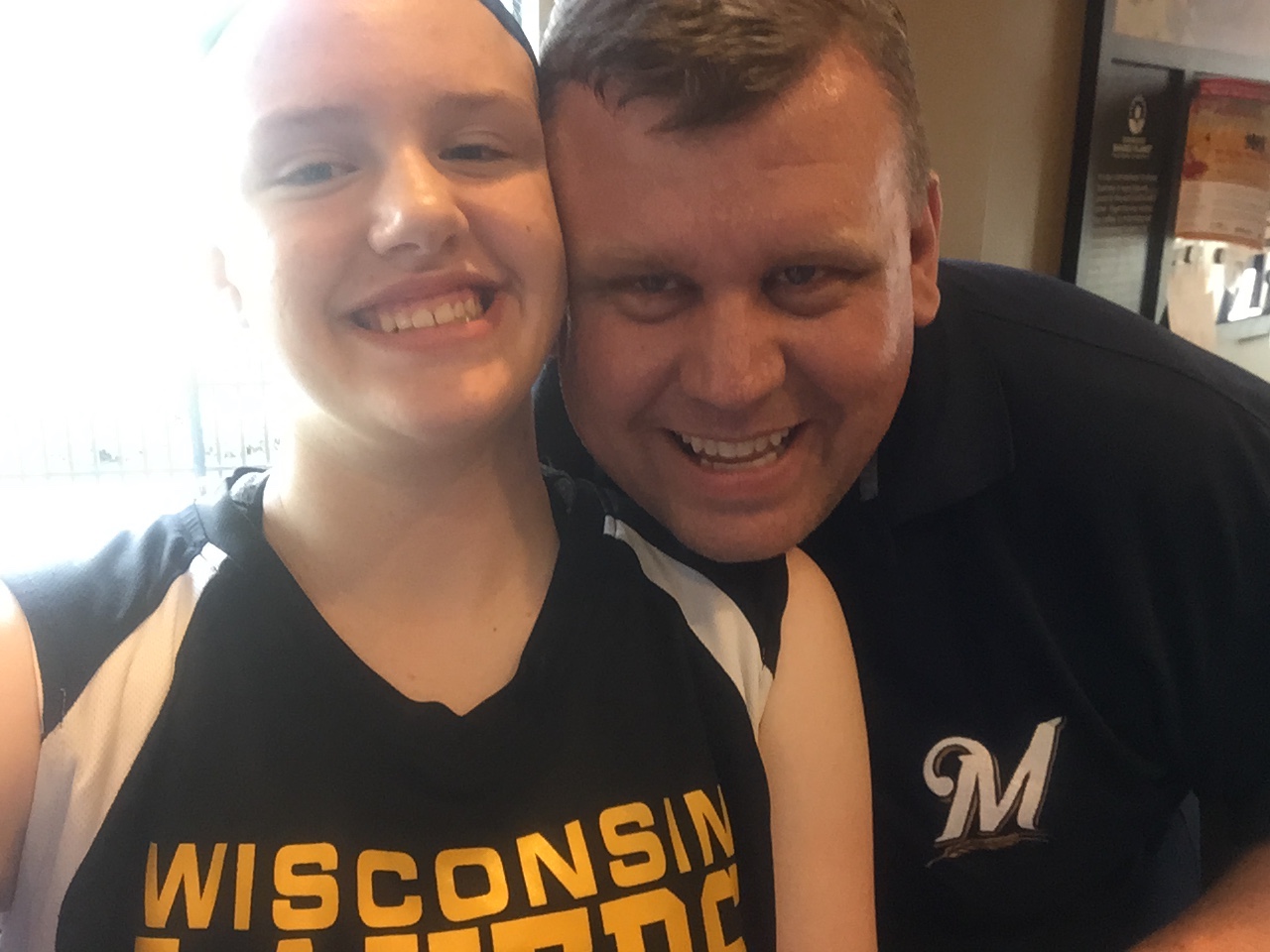
As a man charged with a crime, the law provides me with the right to remain silent.
Today, I am waiving that right.
I would like to enter a plea of guilty to four counts of mistakes I made during my oldest daughter’s basketball career.
I place myself at the mercy of the readers of Youth Basketball Parent.
But before I confess to my crimes, we need to go back to where this story really began.
It was 1989.
My East Troy Trojans were playing the undefeated, 23–0 Palmyra-Eagle Panthers for a regional championship. We were leading 87–86 with seven seconds remaining when our point guard stepped to the free-throw line for a one-and-one.
He missed.
Palmyra-Eagle’s best player grabbed the rebound, raced up the court, pulled up at the elbow, and attempted a 15-footer.
He missed.
The horn sounded, and the crowd stormed the floor.
East Troy had won its first regional championship in 15 years.
It was one of the greatest basketball moments of my young life.
But something else happened on that court that night that would ultimately become far more important.
Somewhere in the chaos, a freshman girl found me in the crowd and gave me a hug.
Ten years later, that girl became my wife.
Basketball was part of both of our lives long before we ever had children.
My wife was an outstanding basketball player at East Troy before playing at UW–La Crosse. I finished my East Troy career as the school’s all-time leading rebounder and later played at Beloit College.
Her brother was a prolific scorer who broke East Troy’s career scoring record before playing at the United States Naval Academy. My brother was an all-conference player at East Troy who went on to play at Lakeland College.
Even our fathers had been accomplished high school basketball players.
Basketball was everywhere.
So perhaps it shouldn’t be surprising that when my wife and I began talking about having children, part of me was already imagining the next generation of Grocholski basketball players.
The Next Generation Arrives
About three years into our marriage, we decided to start a family.
One day, I came home from work and my wife told me I had forgotten to get the mail.
As I walked toward the mailbox, I remember wondering why she hadn’t simply gotten it herself.
I opened the mailbox and found a single envelope.
It had no stamp and wasn’t addressed to anyone.
Inside was a card with a picture of a stork.
We were having a baby.
One of my first thoughts was ridiculous in hindsight:
My son is on the way. The next generation of Grocholski basketball players is about to begin.
Nine months later, my wife gave birth to a beautiful baby girl.
And my entire world changed.
I didn’t know it at the time, but another journey had also begun.
My journey toward becoming a basketball dad.
And unfortunately, I was going to make a lot of mistakes along the way.
Count One: Vanity
Guilty.
One of the hardest lessons I eventually learned as a basketball parent is also one of the simplest:
It isn’t about you.
It’s about your child.
For too long, I allowed my daughter’s basketball success to become a reflection of how I viewed myself as a father.
If she played well, I felt good.
If she struggled, I felt embarrassed.
I worried too much about what other parents thought. I worried about how good she was compared with other players. I worried about whether people thought I knew what I was doing as a basketball dad.
What I should have been worrying about was something much more important:
What does my daughter need from me right now?
Looking back, I would still teach work ethic. I would still encourage her to practice. I would still help her develop her skills.
But I would do it differently.
Instead of acting like her supervisor, I would try to become her partner.
After games, I would start by talking about what she did well rather than immediately identifying everything she needed to fix.
If there were things we needed to work on, I wouldn’t attack them during an emotional car ride home.
I’d wait.
A day or two later, we could go into the driveway together and work on them.
The lesson was simple.
Her basketball career wasn’t supposed to validate me as a father.
My job was to help her.
Count Two: Envy
Guilty again.
When my daughter was in fourth and fifth grade, I would sit in the gym and watch other girls dribble the basketball, make shots, and seemingly do things that my daughter couldn’t do yet.
And I would become jealous.
Why can’t she do that?
Why isn’t she as good as that girl?
Those thoughts drove me crazy.
And the more I compared her with other players, the more pressure I placed on her.
Looking back now, I realize how foolish that was.
Children develop at completely different rates.
Some players dominate when they’re 10 years old and struggle later.
Others barely stand out when they’re young and eventually become excellent players.
Some grow early.
Some grow late.
Some develop coordination quickly.
Others need years.
My daughter’s path was her own.
She wasn’t going to become a better basketball player because I sat in the stands wishing she were someone else.
What she needed was patience.
She needed encouragement.
She needed someone willing to keep helping her build the fundamentals, one day at a time, without constantly comparing her progress with somebody else’s child.
That’s a lesson I wish I had learned much sooner:
Don’t compare your daughter’s Chapter Three with another child’s Chapter Ten.
Let her develop on her own timeline.
Count Three: Wrath
This is probably the count that is hardest for me to admit.
I lost my temper far too often.
I yelled at officials.
I argued with opposing parents.
I got into disagreements with parents from our own teams.
I criticized coaches.
I criticized other people’s children.
And sometimes I did those things with my daughters sitting close enough to hear every word.
There were even occasions when my behavior toward officials resulted in me being removed from a gym.
I’m not proud of any of it.
But one incident stands above all the others.
Hailey was in seventh grade and playing in a tournament at Oak Creek High School.
Her team wasn’t playing well.
In my mind, all the time we had spent practicing wasn’t producing the results I thought it should.
I became angry.
I took Hailey into the hallway.
And I berated her.
In public.
My daughter started to cry.
And suddenly, something changed.
For perhaps the first time in that moment, I stopped looking at her as a basketball player who wasn’t performing to my expectations.
I saw my little girl.
I had hurt her.
Not an official.
Not a coach.
Not another parent.
My daughter.
Over a youth basketball game.
That moment stayed with me.
I wish I could say my behavior changed overnight. It didn’t. Changing habits rarely works that way.
But that day became a turning point.
Year by year, I got better.
I became more aware of my behavior and of what my daughters were seeing when they looked at me in the stands.
This is one lesson I hope other basketball parents can learn without having to experience the moment I did:
There is no youth basketball game important enough to justify hurting your relationship with your child.
Not one.
Count Four: Killing the Love of the Game
This is the count that hurts the most.
As Hailey grew older, basketball became one difficult experience after another.
Naturally, I always thought the problem was somewhere else.
The coach.
The team.
The club.
The situation.
Over the years, I moved her to four different club programs.
I kept searching for the right basketball situation.
There were stretches when she played well and others when she barely played at all.
Despite everything, she made her high school varsity team as a freshman and became a starter during her sophomore season.
From the outside, things appeared to be going pretty well.
But there was something I didn’t understand.
Hailey wasn’t playing basketball because she loved basketball.
In fact, I’m not sure she enjoyed it anymore.
She was playing, at least partly, because of me.
That’s difficult to write.
I’ve often wondered whether my behavior made her believe basketball was somehow tied to my approval of her—or, worse, whether disappointing me on the basketball court might mean disappointing me as her father.
I never wanted her to feel that way.
But my intentions aren’t the only thing that matters.
How my behavior affected her matters too.
At the end of her sophomore year, Hailey finally found the courage to tell me she was done.
She wanted to stop playing basketball and concentrate on volleyball.
I was crushed.
But over time, I came to understand something.
Basketball hadn’t failed Hailey.
Hailey hadn’t failed basketball.
I had helped turn something that was supposed to be fun into something that felt like an obligation.
I had spent so much time trying to develop the basketball player that I sometimes forgot to protect the child’s love of playing.
In that sense, I had helped kill basketball for my daughter.
That realization still hurts.
The Verdict
If you’ve made it this far, perhaps you’ve read some of these stories and thought:
I would never do that.
I hope you’re right.
But I also wouldn’t be too sure.
Most of the mistakes I made didn’t begin because I didn’t love my daughter.
They happened in many ways because I loved her so much and became convinced that pushing her toward success was part of my responsibility as her father.
My intentions were often good.
My execution wasn’t.
Looking back, four lessons stand above everything else:
- Your child’s athletic career belongs to your child—not to you.
- Focus on who your child is rather than who you hope she will become.
- Control your emotions. No youth game is worth damaging your relationship with your son or daughter.
- Encourage their love of the game, but understand that their path may ultimately lead somewhere else.
Fortunately, Hailey’s story didn’t end when she walked away from basketball.
Far from it.
The Happy Ending
Something wonderful happened after Hailey stopped playing basketball.
She found her sport.
Volleyball.
During high school, I watched her confidence grow tremendously. The girl who had endured so many frustrating basketball experiences began thriving on the volleyball court.
And she kept getting better.
During the summer before her senior year, Hailey received a full scholarship offer to play Division I volleyball at Presbyterian College in South Carolina.
I couldn’t have been prouder.
There’s an entire story behind how that opportunity came about, and I’ll save that one for another article.
But Hailey’s journey taught me something I desperately needed to learn.
Our children’s dreams don’t have to be our dreams.
Their path doesn’t have to be the path we imagined for them when they were born.
Sometimes our job as parents is simply to get out of the way long enough for them to discover who they are.
Basketball wasn’t Hailey’s destination.
And that’s okay.
She found her own road.
My responsibility as her father was never to decide where that road should lead.
It was to make sure she always knew that wherever it took her, I would be there beside her.
Thanks for reading Youth Basketball Parent. If you’ve made mistakes as a sports parent, you’re certainly not alone. I hope sharing mine can help another mother or father recognize some of these traps earlier than I did—and perhaps avoid learning these lessons the hard way.