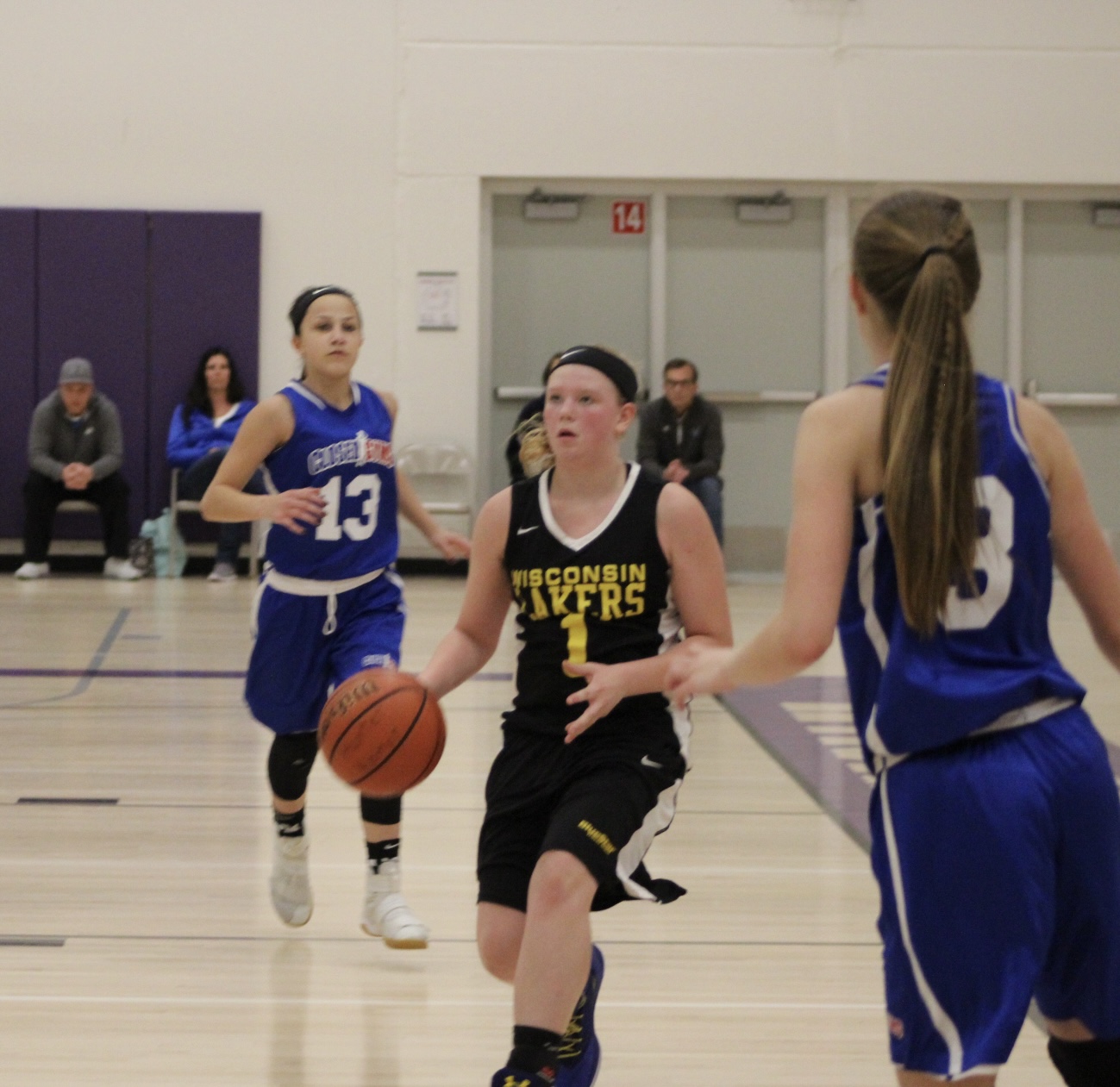
Basketball can be a difficult game.
It requires conditioning, coordination, quick reactions, and countless hours spent developing skills. Players have to learn how to shoot, dribble, pass, defend, rebound, and work with four other people on the court.
And unlike many sports, basketball doesn’t provide much protection.
There are no helmets.
There are no pads.
There isn’t much room to hide.
When you make a mistake, everyone in the gym usually sees it.
Then add everything else that comes with youth basketball.
Coaches.
Teammates.
Officials.
Opposing players.
Fans.
And, of course, parents.
All of them can have opinions about what a young player is doing.
But after spending years watching my daughters play basketball, I’ve come to believe that the most difficult opponent a young athlete will ever face usually isn’t standing across from her.
It’s the opponent between her ears.
The mental side of basketball can determine how a player responds when she misses a shot, gets taken out of the game, loses her starting position, makes a mistake, hears criticism, or simply has a terrible day.
As parents, we can’t control most of those things for our children.
But we can help teach them to focus on two things they can influence:
Their attitude and their effort.
When I Stopped Being the Coach
As my daughters approached high school, I made a conscious decision to stop coaching them.
I believed they needed to hear voices other than mine.
And, like most children as they get older, they were beginning to separate themselves from Mom and Dad and figure out who they were on their own.
That was natural.
But it left me with a question.
If I was no longer going to be their basketball coach, what could I still give them as their father?
I began thinking more about the mental side of sports.
I remember watching Magic & Bird: A Courtship of Rivals, the documentary about Magic Johnson and Larry Bird.
They were very different players with very different personalities, but they shared something remarkable.
They wanted to compete.
They wanted to improve.
And they desperately wanted to win.
Years later, watching The Last Dance and seeing the way Michael Jordan approached competition brought me back to the same question:
Where does that mentality come from?
Is someone simply born with it?
Can it be developed?
Can a parent help teach it?
I don’t pretend to have all the answers.
But I became convinced that if we ask our children to spend hours developing their jump shot, ball handling, and footwork, we should probably spend some time helping them develop the part of the game that takes place inside their head as well.
For our family, that began with attitude.
Secret No. 1: Choose Your Attitude
One of the conversations I began having repeatedly with my daughters was very simple:
What kind of attitude are you going to bring with you today?
Not what kind of attitude is your coach going to have.
Not what kind of mood will your teammates be in.
Not whether the officials make good calls.
Not whether you’re starting.
Not even whether you play well.
Those things aren’t entirely under your control.
But how you respond to them is.
Before practices and games, I would sometimes use a few minutes during the car ride to ask my daughters to think about the attitude they wanted to bring into the gym.
Were they going to be positive?
Focused?
Enthusiastic?
Encouraging?
Were they going to be a good teammate?
And perhaps most importantly:
What would their attitude look like if something went wrong?
Because having a great attitude when you’re making shots and your team is winning isn’t particularly difficult.
The real test comes when you’re struggling.
What I Started Seeing
After we had been discussing attitude for a while, something interesting happened.
One day after practice, my youngest daughter began telling me about the different attitudes she had noticed among the players at practice.
Some girls remained positive.
Others became frustrated.
Some encouraged teammates.
Others withdrew when things weren’t going well.
That conversation stuck with me because she was beginning to notice something beyond basketball skills.
She was recognizing behavior.
More importantly, she was beginning to evaluate her own.
That was exactly what I wanted.
I wasn’t trying to convince her that she would always have a great attitude. None of us do.
I wanted her to recognize when her attitude was moving in the wrong direction and understand that she could make an effort to reset it.
That’s a skill that matters far beyond basketball.
The Real Test Comes When You Aren’t Playing
One of the best examples came from my oldest daughter.
When she was in eighth grade, she played on an extremely talented team.
There were games when she played very little.
Sometimes she didn’t play at all.
As her father, those situations weren’t always easy for me to watch.
I’m sure they weren’t easy for her either.
But I remember looking down the bench and seeing her engaged in the game, cheering for her teammates and celebrating their success even when she wasn’t the one on the court.
That impressed me.
Anyone can celebrate when they’re scoring 20 points.
Can you celebrate when you’re playing two minutes?
Can you encourage the teammate who is playing ahead of you?
Can you stay engaged when you’re disappointed?
Those moments tell us quite a bit about a young person’s character.
And coaches notice them too.
Secret No. 2: Give Great Effort
The second thing I tried to emphasize with my daughters was effort.
Basketball players are not created equally.
Some kids are incredibly fast.
Some are naturally strong.
Some can jump out of the gym.
Others are blessed with height or coordination.
Your child cannot control whether another player is six inches taller or considerably faster.
But there is one thing talent doesn’t automatically provide:
Effort.
I’ve watched thousands of minutes of practices and games over the years, and one thing has always amazed me.
Very few players consistently push themselves anywhere near their full capability.
That doesn’t mean anyone gives maximum effort every second of every practice and every game. That’s unrealistic.
Players get tired.
They become distracted.
They get frustrated.
They’re human.
But the best competitors seem capable of pushing themselves harder—and doing it more consistently—than everyone else.
The Game That Taught Me Something About Effort
When one of my daughters was in seventh grade, she played up a year on an eighth-grade team.
We were playing the first tournament of the club season in Waukegan, Illinois.
Our club director had arranged the schedule so the organization’s top team played immediately after ours. That meant there were more than 20 coaches around the court watching the end of our game.
Our team was down by approximately 10 points with four minutes remaining.
The coach called for a full-court, man-to-man press.
And something happened.
My daughter’s intensity suddenly went to another level.
She pressured the basketball.
She sprinted.
She fought through screens.
Her effort was noticeably different from what it had been earlier in the game.
We didn’t win.
But afterward, I realized that I had just been given a terrific teaching opportunity.
Instead of telling her what she had done wrong earlier, I asked her a question.
“What allowed you to raise your effort to that level during the last four minutes?”
And then came the more important question:
“Could you find a way to play closer to that level more often?”
She had already demonstrated that the effort existed inside her.
The challenge was learning how to access it without needing a scoreboard, a coach, a crowd, or 20 people watching from the sideline to bring it out.
That is the mental game.
Ask Questions Instead of Giving Speeches
This is something I wish I had understood better when my daughters were younger.
Parents don’t always have to give the answer.
Sometimes the better approach is asking the question.
Instead of:
“You didn’t play hard enough today.”
Try:
“How would you rate your effort today from 1 to 10?”
Instead of:
“Your attitude was terrible when the coach took you out.”
Try:
“What were you feeling when you came out of the game?”
Then listen.
You might be surprised by the answer.
The purpose shouldn’t be to interrogate your child during every car ride home.
I’ve made that mistake.
The purpose is to gradually help your child become capable of evaluating herself.
Ultimately, that’s what we want.
Someday Mom and Dad won’t be sitting next to her before practice reminding her to have a good attitude and give great effort.
She has to learn to do that herself.
The Lesson for Basketball Parents
There are so many things in youth basketball that neither parents nor players can control.
You cannot control the officials.
You cannot control the coach’s lineup.
You cannot control how many shots your child gets.
You cannot control whether another player is more athletic.
You cannot control what another parent says from the stands.
And sometimes you cannot even control the final score.
Trying to control those things will make both you and your child miserable.
Instead, I’ve tried to teach my daughters to bring their attention back to two questions:
What attitude am I bringing today?
How much effort am I willing to give?
Those two things won’t guarantee that your child becomes an All-Conference player.
They won’t guarantee a college scholarship.
They won’t guarantee that she starts.
They won’t even guarantee that her team wins.
But they will give her something much more valuable.
Ownership.
She begins to understand that while she cannot control everything that happens to her, she has some control over how she responds to what happens to her.
And isn’t that ultimately one of the reasons we put our children in sports in the first place?
We’re not simply trying to create better basketball players.
We’re trying to help raise young people who can face disappointment, respond to adversity, work hard, support others, and keep moving forward when things don’t go their way.
The jump shot matters.
The ball handling matters.
The conditioning matters.
But long after the final basketball game is over, attitude and effort will still matter.
Maybe that’s the real victory.
One final thought
I think that final section is important for this particular article because it explains why a parent should care about attitude and effort even if their child never becomes an elite player. It moves the piece beyond basketball and back to the larger idea behind your website: using youth sports to help raise our children.
There’s also a sentence I would make one of the visual pull-quotes on the page:
“We’re not simply trying to create better basketball players. We’re trying to help raise young people.”
That, to me, is what this article is actually about—and increasingly, I think it’s what Youth Basketball Parent is about too.