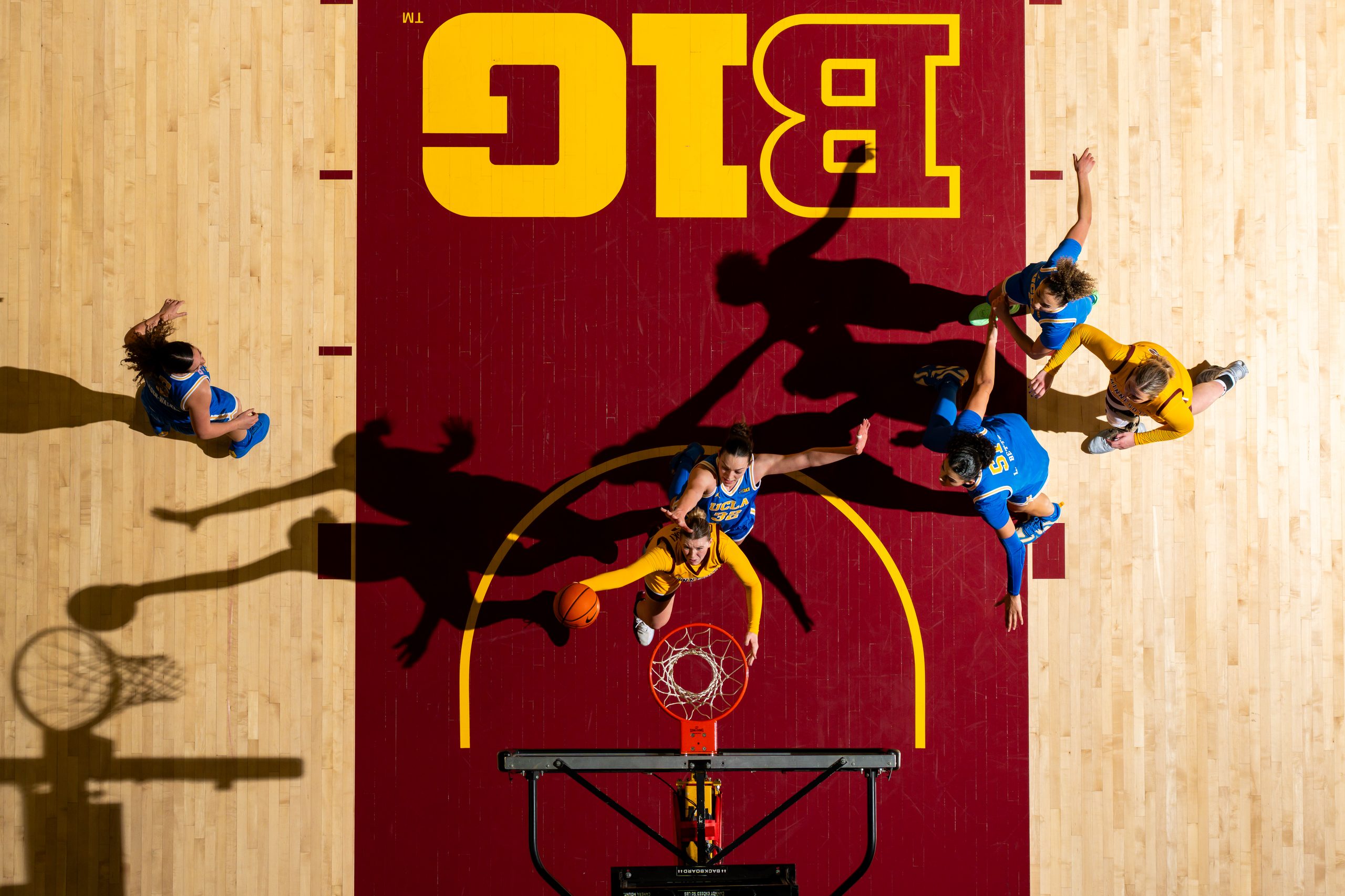
Photo Credit: Gopher Athletics
There is no question that modern basketball has become increasingly focused on the three-point shot.
And there is a good reason for it.
Mathematically, three points are obviously worth more than two. A team can score 12 points by making six two-point field goals—or only four three-pointers.
As a result, players at virtually every position are now encouraged to stretch the floor and develop their perimeter shooting.
I completely support that philosophy.
I have spent countless hours helping my daughters become better three-point shooters.
But I also believe something valuable has been lost as basketball has moved farther and farther away from the basket:
The ability to score in the post.
I believe young players should learn how to score with their backs to the basket—even if they primarily play guard or wing positions.
In fact, I think post skills can be especially valuable for guards.
Become Difficult to Guard
My daughter primarily played shooting guard for her club team, but over the years I created drills that helped her develop the footwork necessary to score around the basket.
That additional skill became an important part of her game.
Why?
Because it created a matchup problem.
If the opposing team put a taller player on her, she could attack that player from the perimeter.
If they defended her with a smaller guard, she could take the defender into the post.
That is what I mean by becoming an inside-outside threat.
Instead of allowing the defense to dictate where you play, you develop enough skills to attack whatever matchup is placed in front of you.
Basketball becomes much easier when the defender has to choose between two bad options.
Post Moves Aren’t Just for Post Players
When many parents hear the phrase “post moves,” they picture a center standing with her back to the basket.
I would encourage parents to think differently.
A guard may receive the basketball in the post after a switch.
A wing may have a smaller defender guarding her.
A player may catch the ball near the block after an offensive rebound.
A transition opportunity may create a mismatch before the defense gets organized.
Players who already understand post footwork can recognize those situations and take advantage of them.
A player who has never practiced with her back to the basket may not even realize the opportunity exists.
That is why I believe all young players should spend at least some time developing a basic post game.
Footwork Comes First
Good post scoring is not primarily about being tall.
It is about footwork, balance, patience, and deception.
A player needs to understand how to establish a pivot foot.
She needs to protect the basketball.
She needs to use her body legally to create space.
She needs to recognize where the defender is positioned.
And perhaps most importantly, she needs to learn how to make the defender believe she is going one direction before attacking another.
That takes repetition.
At first, the movements may feel mechanical.
Drop step.
Pivot.
Fake.
Finish.
But after hundreds—or thousands—of repetitions, the movements begin to happen naturally.
That is the goal.
When your child gets the basketball during a game, you don’t want her thinking:
“Okay, first I pivot here. Then I put my foot there.”
You want her to recognize the defense and react instinctively.
Five Post Moves We Consistently Work On
There are five moves that we repeatedly practiced in an effort to make them second nature.
1. Power Drop Step
The drop step is one of the most fundamental post moves in basketball.
The player reads the defender, steps strongly toward the basket with the foot closest to the baseline or middle, seals the defender with her body, and finishes at the rim.
This is a great foundational move because it teaches balance, footwork, body positioning, and how to finish through contact.
A strong drop step can be effective regardless of a player’s size.
2. Fake Baseline Into a Turnaround Jump Shot
This move begins with deception.
The offensive player makes the defender believe she is attacking the baseline.
Once the defender reacts, the player pivots back toward the middle and rises for a turnaround jump shot.
The fake is what creates the space.
Young players sometimes rush through fakes because they already know where they intend to go.
The defender doesn’t know.
Sell the fake.
Make the defender believe it.
Then make your move.
3. Fake Middle Into a Right-Hand Hook Shot
The hook shot is another skill that has become less common in youth basketball.
That is unfortunate because it can be extremely difficult to defend.
The player’s body stays between the defender and the basketball while the shot is released with the outside hand.
A good fake toward the middle can shift the defender just enough to create the opening needed for the hook.
Your child does not have to shoot a sweeping Kareem Abdul-Jabbar skyhook.
A short, controlled hook around the lane can be incredibly effective.
4. Fake Baseline Into a Left-Hand Hook Shot
This is essentially the mirror image of the previous move.
And that brings up something I strongly believe:
Players should learn to finish with both hands.
Defenses become much easier to play against when an offensive player can only go one direction.
If your child can finish with either hand, she becomes much more difficult to predict.
Working on a left-handed hook may feel uncomfortable at first for a right-handed player.
That is exactly why she should practice it.
Basketball development often begins by becoming comfortable being uncomfortable.
5. The Up-and-Under
The up-and-under may be my favorite post move.
It rewards patience.
The player begins by making the defender believe she is going to shoot.
When the defender leaves her feet to block the shot, the offensive player stays grounded, steps underneath or around the defender, and finishes at the basket.
The most important part of the move is the shot fake.
Again:
Sell it.
Eyes toward the rim.
Ball up.
Body language that says you are about to shoot.
Once the defender commits, you have created the advantage.
Young players often believe basketball has to be played at full speed all the time.
The up-and-under teaches something different.
Sometimes the best basketball move is getting the defender to move first.
Post Scoring Creates Confidence
One of the things I enjoyed about teaching these moves was watching my daughter’s confidence grow.
There is something powerful about knowing you have another option.
Maybe the three-point shot isn’t falling.
Maybe a defender is crowding you on the perimeter.
Maybe the defense switches a smaller guard onto you.
Now you have somewhere else to go.
Take the basketball to the block.
Get into your move.
Attack the mismatch.
A complete basketball player should always be looking for different ways to help her team score.
The more tools she has, the more difficult she becomes to defend.
Don’t Let Your Child Become One-Dimensional
I love the three-point shot.
I want young players to become excellent shooters.
But I don’t want them to become dependent on one part of their game.
A player who can only shoot from the perimeter becomes easier to defend.
A player who can shoot, drive, pass, and score in the post forces the defense to make decisions.
And defensive decisions eventually create mistakes.
That is why I would encourage parents to spend some time teaching post footwork—even if your child is a guard.
You don’t have to spend hours every day working on it.
Add a few moves to your driveway workouts.
Practice finishing with both hands.
Work on pivots.
Work on fakes.
Repeat the same movements until they begin to feel natural.
Then look for opportunities to use them during games.
Watch the Five Post Moves
Below this article, I have included a video demonstrating the five post moves discussed above:
Power Drop Step
Fake Baseline Turnaround Jump Shot
Fake Middle Right-Hand Hook Shot
Fake Baseline Left-Hand Hook Shot
Up-and-Under
When watching the video, don’t focus only on whether the shot goes in.
Watch the feet.
Watch the pivot.
Watch how the basketball is protected.
Watch the body positioning.
And most importantly, watch how each fake is used to move the imaginary defender before the scoring move begins.
[POST-MOVES VIDEO]
Build a Complete Basketball Player
Basketball will continue to evolve.
Three-point shooting will remain an enormous part of the game.
Players will continue to become more skilled on the perimeter.
That is a good thing.
But sometimes an advantage can be created by developing a skill that fewer players are practicing.
Post scoring may be one of those opportunities.
Teach your child to shoot the three.
Teach her to handle the basketball.
Teach her to attack the rim.
But don’t forget to teach her what to do when she catches the basketball with her back to the basket.
Because when a defender takes away one part of her game, the best players have another answer.
The goal isn’t to create a post player.
The goal is to create a complete basketball player.
Thank you for reading Youth Basketball Parent. I hope the video below gives you a few ideas you can take into the driveway or gym and begin practicing with your child.