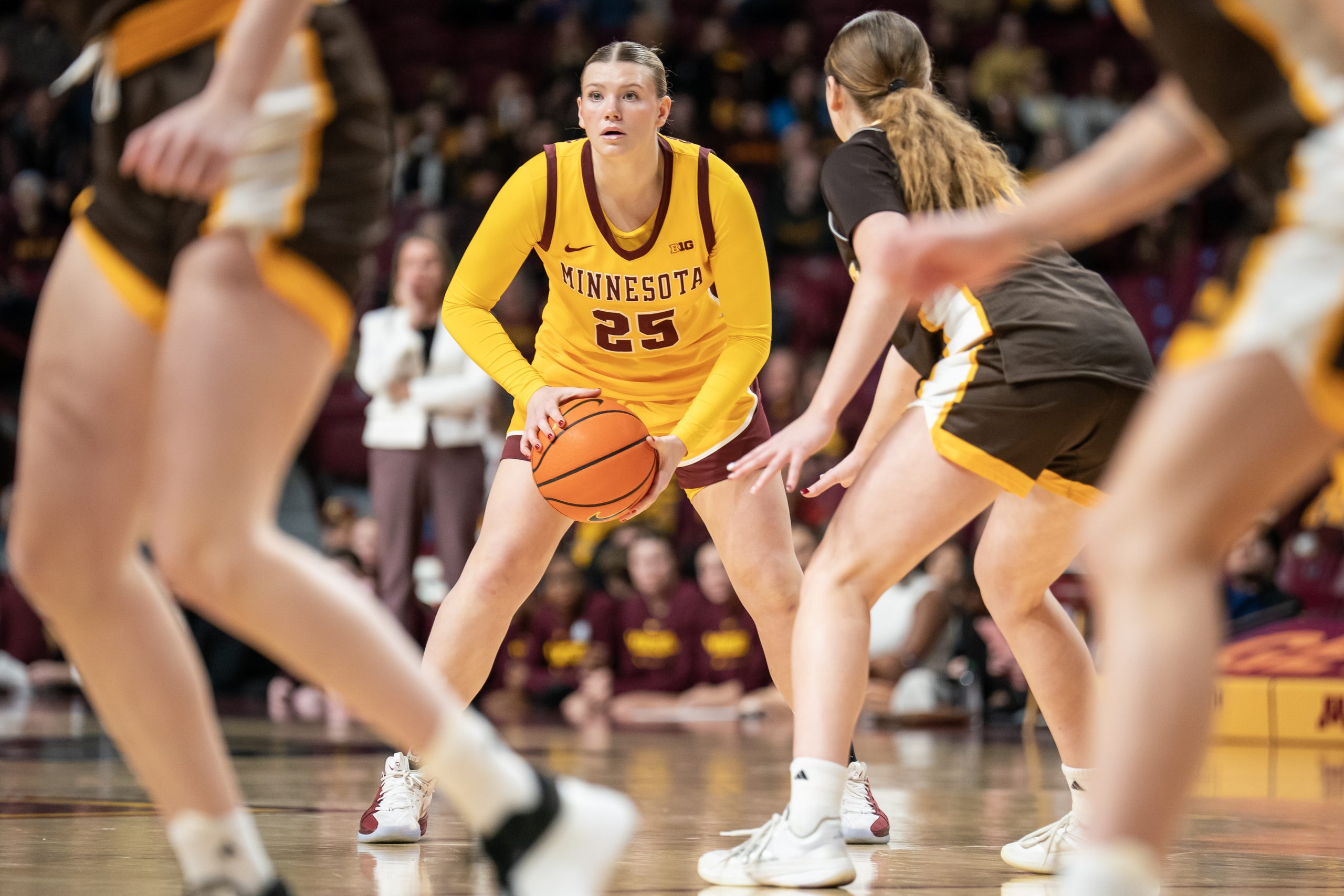
Photo credit: Gopher Athletics
Coaches will beg.
Parents will scream.
Referees will shake their heads.
And somewhere, high above the hardwood, the basketball gods will wonder what they did to deserve this.
Anyone who spends enough time watching youth, high school, or club basketball eventually sees certain things that make basketball purists cringe.
The frustrating part is that most of them have very little to do with talent.
You don’t have to be tall to box out.
You don’t need elite speed to sprint back on defense.
You don’t have to be a great shooter to have good body language.
And you certainly don’t need a college scholarship offer to understand that screaming at a referee probably isn’t going to help your team.
So, basketball parents, take notes.
Warn your children.
Do your part.
Together, perhaps we can prevent the next generation of players from committing these ten sins against the basketball gods.
1. Failure to Box Out
When you really think about it, boxing out should be one of the simplest concepts in basketball.
A shot goes up.
Find the player you are guarding.
Make contact.
Keep that player away from the basketball.
Then go get the rebound.
Simple, right?
Apparently not.
I have sat through weekends of basketball where possession after possession ends with defenders immediately turning toward the basket and watching the ball instead of first locating an offensive player.
By the time they realize what happened, the opponent has grabbed an offensive rebound and earned another possession.
A defensive possession isn’t over when the shot goes up.
It is over when your team controls the basketball.
Every player on the floor has a responsibility to box out, whether she is standing underneath the basket or behind the three-point line.
It needs to become a habit.
Shot goes up.
Find somebody.
Make contact.
Then get the ball.
Do this consistently, and somewhere the basketball gods will smile.
2. Posing or Celebrating Instead of Playing
We see celebrations throughout basketball.
A player makes a three-pointer and poses.
Someone blocks a shot and stares down the opponent.
A big play happens and suddenly there is a lot of chest pounding and flexing.
Young players naturally imitate what they see from professionals and on social media.
I understand celebrating with your teammates.
Basketball is emotional, and great plays are fun.
But there is a difference between celebrating with your team and trying to embarrass an opponent.
My experience has taught me that basketball is ultimately a team game.
Let your play do the talking.
Hit the three-pointer?
Great.
Now sprint back on defense.
Block the shot?
Outstanding.
Go get the loose ball.
Your team has a big lead?
Then continue playing the game the right way.
Confidence is a wonderful thing.
Sportsmanship is, too.
Teach your children to make their success about the team rather than creating a personal highlight show every time something goes right.
3. Showing Up a Referee
Let me share one of basketball’s great universal truths:
Referees are going to miss calls.
They are human.
Sometimes the missed call will benefit your team.
Sometimes it will hurt your team.
Over all my years watching basketball, I can remember very few occasions when a player screaming at an official caused the referee to say:
“You know what? You’re right. Let me reverse that call.”
Usually, the opposite happens.
The player becomes distracted.
The team is suddenly playing four-on-five because somebody is still complaining while everyone else is running down the court.
Or worse, the player receives a technical foul.
Players need to develop a next-play mentality.
Bad call?
Next play.
Missed shot?
Next play.
Turnover?
Next play.
Parents can help tremendously by reinforcing this message rather than criticizing officials from the stands.
Teach your child to focus on the things she can control.
The referee’s whistle isn’t one of them.
4. Dribbling to Nowhere
Basketball players love to dribble.
Sometimes, I think they love it a little too much.
A player catches the basketball and immediately puts it on the floor.
Why?
Where are you going?
What are you trying to accomplish?
The fastest way to move a basketball around the court isn’t by dribbling.
It is by passing.
A player should dribble with a purpose.
Dribble to attack the basket.
Dribble to escape pressure.
Dribble to improve a passing angle.
Dribble to create an advantage.
But don’t dribble simply because you happen to have possession of the basketball.
Quick ball movement forces defenders to move.
Defenders who are constantly moving eventually make mistakes.
Those mistakes create open shots, driving lanes, post-entry opportunities, and defensive rotations that an offense can exploit.
I would encourage young players to develop the habit of catching the basketball and first seeing the floor.
You don’t receive bonus points for the number of dribbles you take.
Sometimes the best basketball decision is the simplest one:
Catch it. Move it.
5. Poor Shot Selection
I love watching Stephen Curry play basketball.
There may never have been anyone better at making extraordinarily difficult three-point shots look reasonable.
But there is one small problem.
Your 12-year-old probably isn’t Steph Curry.
Yet spend enough time at a youth basketball tournament and eventually you will see a player launch a shot from several feet beyond the three-point line while perfectly good offensive options remain available.
Why?
Because Steph makes it look fun.
Poor shot selection isn’t limited to deep three-pointers, either.
Sometimes you can almost see a player make the decision:
“I haven’t shot the ball lately. This possession is mine.”
Then comes the dribbling.
The crossover.
Another crossover.
Maybe a spin.
And finally, a contested shot over two defenders.
I always told my daughters:
Let the game come to you.
Move the basketball.
Reverse it from one side of the court to the other.
Get it into the post.
Kick it back outside.
Make the defense work.
Eventually, good ball movement creates good shots.
The objective isn’t to take the most difficult shot you can possibly make.
The objective is to create the easiest shot your team can get.
There is an enormous difference.
6. Pouting on the Bench
Every basketball player has bad days.
Shots won’t fall.
Minutes may be limited.
A coach might say something your child doesn’t like.
A teammate may appear to be getting more opportunities.
Your child will become frustrated at some point.
That is normal.
What matters is what happens next.
Sitting at the end of the bench with crossed arms, rolling eyes, refusing to cheer for teammates, or displaying miserable body language doesn’t improve the situation.
It usually makes it worse.
Coaches notice body language.
Teammates notice it.
Parents notice it.
And yes, if college coaches happen to be watching, they notice it too.
I always tried to teach my daughters that two things are available regardless of how the game is going:
effort and attitude.
Shot isn’t falling?
Play great defense.
Not getting enough touches?
Go get an offensive rebound.
Struggling offensively?
Set a great screen. Make the extra pass. Dive for a loose ball.
Not currently in the game?
Be the best teammate on the bench.
Players cannot always control their circumstances.
They can control how they respond to them.
7. Failure to Close Out Properly
Few defensive mistakes make coaches more frustrated than watching a player sprint wildly toward a shooter, fly past her, and give up an uncontested drive to the basket.
There is a reason coaches spend so much time teaching closeouts.
A good closeout requires balance.
The defender needs to cover ground quickly and then arrive under control—shortening her steps, getting into a defensive stance, and preparing to defend either the shot or the drive.
Closing out properly isn’t glamorous.
Nobody posts a highlight video titled:
“Amazing Defensive Closeouts — Must Watch!”
But coaches notice.
Defense is filled with small techniques that separate dependable players from everybody else.
Learning how to close out correctly is one of them.
8. Failure to Sprint Back on Defense
Want to discover one of the fastest ways to get yourself removed from a basketball game?
Jog back on defense.
This one has always amazed me because it requires virtually no special basketball skill.
You don’t need great ball handling.
You don’t need a reliable jump shot.
You don’t need exceptional height.
You simply have to run.
The moment possession changes, sprint back.
Missed a layup?
Sprint back.
Turned the ball over?
Sprint back.
Think you got fouled?
Sprint back.
Upset with your teammate?
Sprint back.
You can discuss everything else later.
Transition defense is about effort and basketball awareness.
Make sprinting back such a strong habit that your child does it automatically.
Coaches love players they don’t have to constantly remind to hustle.
9. Talking Back to a Coach
I remember an incident from when my brother was a senior in high school.
His team was playing a game in Lake Geneva. During the first half, one of his teammates made a mistake and the coach removed him from the game.
The player became furious.
When he reached the bench, the situation escalated dramatically. He screamed profanities at the coach and physically attacked him.
Obviously, that is an extreme example.
But it has stuck with me because it represents what can happen when frustration completely overwhelms respect and self-control.
Players are not going to agree with every coaching decision.
Parents aren’t going to agree with every coaching decision either.
I’ve certainly had moments when I questioned coaches during my daughters’ basketball journeys.
But there are appropriate ways to handle disagreements.
A player screaming at a coach during a game rarely solves anything.
If there is a legitimate problem, the player or parent can address it calmly at an appropriate time. And if a coach’s behavior is truly inappropriate, abusive, or unsafe, parents absolutely should intervene through the proper channels.
Respect does not mean blindly agreeing with everything a coach does.
It means handling disagreement in a mature manner.
That is an important lesson in basketball.
It is an even more important lesson in life.
10. Lack of Effort
Everybody on a basketball team eventually figures out who works hard.
Players know.
Coaches certainly know.
They know who sprints from drill to drill.
They know who plays defense during practice when nobody is keeping score.
They know who finishes conditioning exercises.
They know who dives after loose balls.
And they know who mysteriously operates at half-speed whenever the work becomes difficult.
Talent levels vary tremendously.
Effort doesn’t have to.
A player may never be the tallest person on the team.
She may never be the fastest.
She may never become the best shooter.
But there is absolutely no reason she cannot compete to be one of the hardest-working players in the gym.
That is something I would encourage every basketball parent to teach early.
Don’t wait until high school.
Make effort a habit when your child is young.
Because coaches can teach shooting mechanics.
They can teach offensive sets.
They can teach defensive rotations.
It is much harder to teach a player to care.
Keep the Basketball Gods Happy
The funny thing about this list is that none of these ten items requires extraordinary talent.
That is exactly why they matter.
Box out.
Respect the opponent.
Leave the referees alone.
Dribble with a purpose.
Take good shots.
Have good body language.
Close out properly.
Sprint back on defense.
Respect your coach.
Give great effort.
Those aren’t the characteristics of the most talented basketball player.
They are the characteristics of a good basketball player and a good teammate.
And here’s something I’ve learned after spending a lot of years around this game:
Coaches notice the little things.
Parents should notice them too.
We naturally celebrate points, three-pointers, great passes, and big wins.
But basketball can teach our children something much more valuable than how to put a ball through a hoop.
It can teach discipline.
It can teach accountability.
It can teach humility.
It can teach respect.
It can teach effort.
And it can teach a young person that doing the small things correctly, consistently, eventually leads to bigger opportunities.
So please, basketball parents, talk to your kids.
Teach them the game.
Teach them the little things.
And whatever you do…
Don’t anger the basketball gods.